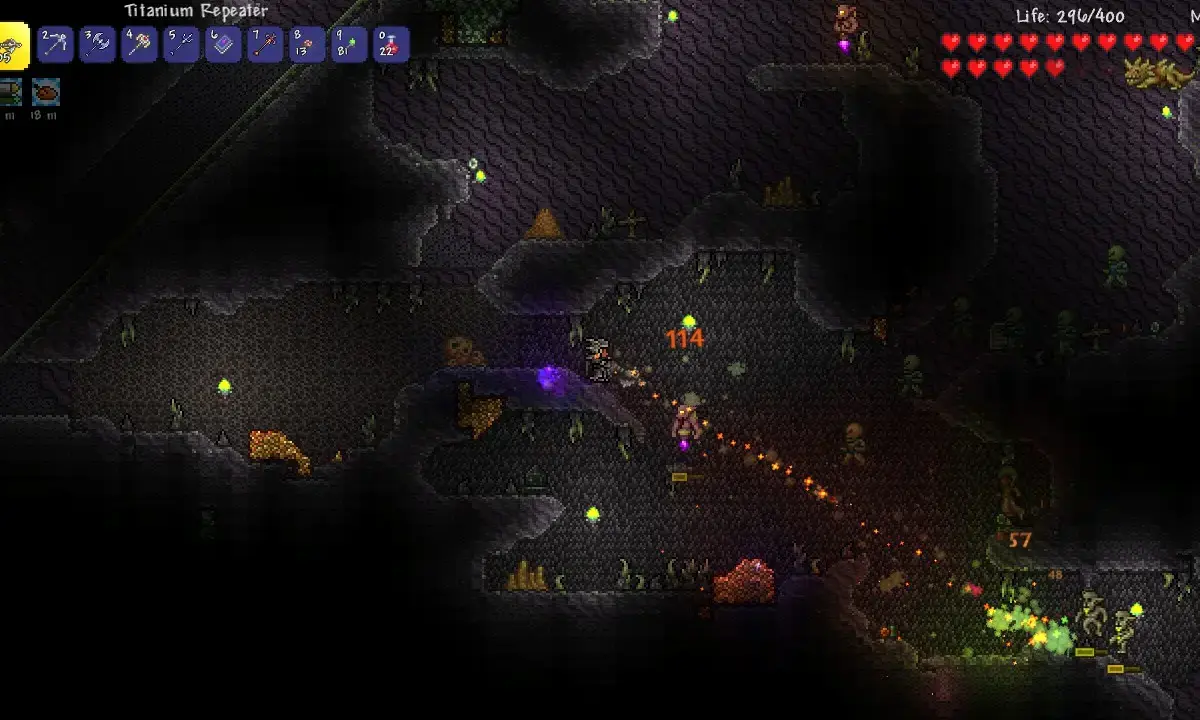
An AI experiment that recreated Re-Logic’s Terraria overnight has sparked backlash among game developers and players, raising questions about what increasingly capable coding agents could mean for game ownership and intellectual property.
AI engineer Rehan Sheikh posted about the experiment on X, on Sept. 28, claiming he had pointed Anthropic’s recently released Claude Opus 5.5 at Terraria before going to sleep and woke up to what he described as a “fully working reverse engineered version” of the game.
“All games are open source now!” Sheikh said, with a video showing the project running. He subsequently added a homing missile launcher, tactical nuke and new enemies, with additional sprites and sound effects generated using tools accessed through AI infrastructure company fal, where Sheikh works.
The demonstration quickly attracted criticism, including reactions from game developers and other AI users. Sheikh later clarified that the project was an experiment and said he doesn’t intend to distribute or monetize it.
What Did Rehan Sheikh’s AI Terraria Experiment Do?
Terraria was originally released in 2011 on PC and remains actively developed and sold by Re-Logic. Its sandbox structure combines procedurally-generated worlds with mining, building, crafting, exploration and combat.
According to Sheikh, Claude Opus 5.5 was able to reproduce enough of Terraria overnight for him to describe the result as fully working. His demonstration showed recognizable Terraria-style gameplay before he began expanding the recreation with features that aren’t part of the original game.
The experiment is especially notable because Opus 5.5 only launched Sept. 22. Anthropic describes its latest model as being designed for long-running agentic coding tasks, where AI can autonomously work through substantial software projects rather than simply generating isolated snippets of code.
Sheikh’s wording also contributed to the reaction. He called the AI work proof that “all games are open source now,” suggesting that, as they become more capable, AI agents could effectively recreate software without developers voluntarily publishing their original source code.
That’s different from Terraria actually becoming open source. Re-Logic hasn’t released Terraria’s proprietary source code, and Sheikh’s project is a separate AI-generated recreation based on Terraria rather than the actual original game code.
Why the AI Terraria Recreation Drew Backlash
The technical achievement wasn’t the only part of Sheikh’s experiment attracting attention. Much of the discussion instead focused on whether developers should use AI to recreate somebody else’s commercially available game in the first place.
AI & Design’s Marco, whose account routinely covers and advocates for AI-assisted creative technology, was among those criticizing the experiment.
“As a huge AI enthusiast I don’t actually like this one bit,” he said, arguing that recreating an old game no longer commercially available would be different from reproducing something such as Terraria, which Re-Logic continues to sell.
Other responses were considerably stronger, with some users describing the experiment as theft or an unauthorized clone. Game developer and YouTuber Barji was also among those who weighed in as the post circulated through game development communities.
The reaction prompted Sheikh to clarify his intentions. He said the experiment was “solely to see if this could be done” and added that he doesn’t plan to release or monetize the recreation.
His clarification matters, although it doesn’t eliminate the wider questions raised by the experiment. No legal ruling has established that Sheikh’s demonstration itself constitutes copyright infringement, and recreating game mechanics isn’t necessarily equivalent to copying original source code. However, AI-generated recreations can also raise questions around copyrighted artwork, audio, characters and other expressive elements depending on what material is reproduced and how it was produced.
In other words, the controversy isn’t simply about whether AI can make games. It’s about what happens when increasingly autonomous development tools are directed at games somebody else has already made.
AI and Vibe Coding Are Already Changing Game Development
Sheikh’s experiment arrives as generative AI becomes increasingly visible across game development. GDC’s 2026 State of the Game Industry survey found 36% of industry professionals already use generative AI tools as part of their jobs. Research and brainstorming were the most common uses, while 47% reported using them for code assistance and 35% for prototyping.
Those applications range from relatively conventional development assistance, such as generating boilerplate code, debugging and rapidly testing prototypes, to creating artwork, 3D assets, animation, voices and sound.
Sheikh has demonstrated similar workflows himself. In another recent experiment, he described combining AI-generated concept art, Hunyuan 3D, a custom C++ voxelizer, and an AI-controlled Blender workflow to create, rig and animate game creatures.
Game engines are moving in the same direction. Unity has been developing AI-assisted authoring technology designed to let creators generate playable experiences through natural-language instructions, while Meta recently revealed Horizon Create and Horizon Studio, which use prompting to help users build 2D and 3D games.
This overlaps with “vibe coding,” a term popularized by AI researcher Andrej Karpathy in 2025. Rather than manually writing and reviewing every line of code, developers describe what they want in natural language, allow an AI coding agent to implement it, then repeatedly test and refine the result through further prompts.
The approach is already substantial enough to support dedicated competitions. The 2026 AI Vibe Jam required at least 90% of submitted games’ code to be written by AI and attracted 945 entries.
However, the industry remains deeply divided. The same GDC survey also found increasingly negative attitudes toward generative AI, illustrating the distinction many developers make between using AI as an assistant versus using it to replace or reproduce creative work.
The Last Word
Whether developers welcome generative AI or reject it, there’s little doubt that the technology is gaining traction in game development. Coding agents are increasingly capable of prototyping mechanics, generating assets and completing substantial development tasks, while “vibe coding” is lowering the technical barrier to producing playable games.
Sheikh’s Terraria experiment pushes that development into much more contentious territory. Using AI to accelerate an original project is one thing; directing it toward recreating a commercially available game raises different questions about consent, attribution, ownership and creative control. Sheikh says the project won’t be released or monetized, but the experiment demonstrates how rapidly the technical barrier to this kind of AI-assisted cloning is being lowered.
Other Gaming Content
- SharpEmu Can Now Run Six PS5 Games at 60 FPS on PC
- All changes in The Witcher 3: Wild Hunt Remastered
- How Gorr the God Butcher Changes The Meta in Marvel Rivals
Featured Image Credit
Image via Steam